What this section does
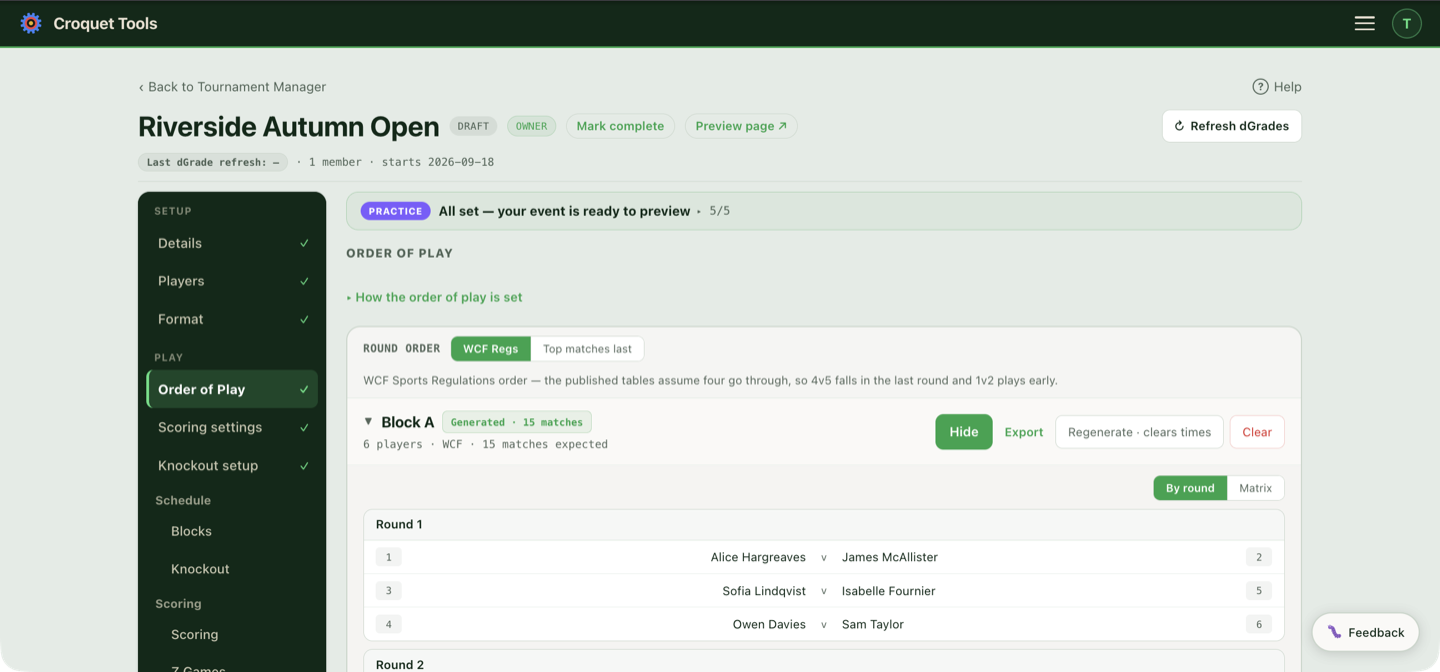
Order of Play turns each block into an actual sequence of matches — who plays whom, in which round. The schedule then places those matches on lawns and times; this section only decides the order.
Settings
Block play
Offered once a competition has two or more blocks. It decides who a block's players play:
- Within blocks — each block is a round robin among its own players. A block of 5 gives everyone 4 games, one round of the five sitting out.
- Cross block — the blocks pair off in order, the first with the second and the third with the fourth, and every game is against the paired block. A block of 5 paired with a block of 5 gives everyone 5 games, five rounds of five games with nobody sitting out. An odd block at the end plays within itself.
Under cross block each block keeps its own standings, ranked on its games against the other block — its players all faced the same opposition, so that is the one fair comparison, and the knockout seeds "Block A 1st v Block B 2nd" exactly as any two-block competition does. Head-to-head can never break a tie inside a block, since two players of the same block never meet; the chain runs on to the next tiebreaker. On the public page the pair's views are drawn once rather than once per block. The view beside Standings is named Cross block, and holds a single grid: one block down the side, the paired block across the top, each game in a cell once, with the paired block's wins and net hoops along the foot. Order of play lists the pair's rounds once. Standings stays one table per block, since each block is ranked separately.
The rotation puts each block's seed 1 against the other's seed 1 in the final round, 2 against 2 and so on, so the games likeliest to decide each block come last; a smaller block's missing seeds are byes for the larger. Round order does not apply and is hidden. Generating, rebuilding or clearing either block of a pair does it for the pair, and the Order of Play lists each block's games with a note of who it plays.
Round order
Everyone plays everyone either way — the choice is only about which round each match falls in:
- WCF Regs — the order published in the WCF Sports Regulations, adapted to the competition's qualifier count (below).
- Top matches last — the app's own order: the widest seed gaps come first, and the rounds get closer as the day goes on.
This is the same setting offered on Format, where answering Then what? preselects the order that suits the answer: Top matches last when block standings decide, WCF Regs when a knockout follows. Choosing it there costs nothing because no pairings exist yet; changing it here re-deals them, keeping every scheduled time.
Here is a block of 8 under each. The numbers are seeds — 1 is the block's top seed:
| Round | WCF Regs | Top matches last |
|---|---|---|
| 1 | 1v4 · 2v5 · 3v7 · 6v8 | 1v5 · 2v6 · 3v7 · 4v8 |
| 2 | 1v6 · 2v3 · 4v8 · 5v7 | 1v6 · 2v5 · 3v8 · 4v7 |
| 3 | 1v3 · 2v6 · 4v7 · 5v8 | 1v7 · 2v8 · 3v5 · 4v6 |
| 4 | 1v5 · 2v4 · 3v8 · 6v7 | 1v8 · 2v7 · 3v6 · 4v5 |
| 5 | 1v2 · 3v4 · 5v6 · 7v8 | 1v3 · 2v4 · 5v7 · 6v8 |
| 6 | 1v7 · 2v8 · 3v5 · 4v6 | 1v4 · 2v3 · 5v8 · 6v7 |
| 7 | 1v8 · 2v7 · 3v6 · 4v5 | 1v2 · 3v4 · 5v6 · 7v8 |
Read the last round of each: WCF Regs ends on 4 v 5; Top matches last ends on 1 v 2, 3 v 4, 5 v 6, 7 v 8. The ▸ How the order of play is set fold in the tool shows the pattern for every block size.
WCF Regs and the number of qualifiers
The published tables are written for blocks whose top four go through to a knockout: the games among seeds 3–6 — the seeds either side of the qualifying line — fall in the closing rounds, ending on 3v6 and 4v5, while 1v2 plays early.
The tables work on seeds, not on the table as it stands. Seeds 4 and 5 are the pair the seeding expects to be on the cusp, so their game is dealt last — but if results diverge from the seeding, the last round may hold nothing that matters and the block may have been settled two rounds earlier. No round order can prevent that; it places games before any of them are played.
When the competition's knockout takes a different number through (How many from each block go through? on Knockouts), the same table is dealt with the seeds renumbered so the qualification cusp still lands late. With two qualifiers per block the deciding games are among seeds 1–4, and a block of 8 becomes:
| Round | WCF Regs · 2 qualifiers |
|---|---|
| 1 | 1v5 · 2v7 · 3v8 · 4v6 |
| 2 | 1v8 · 2v6 · 3v5 · 4v7 |
| 3 | 1v7 · 2v5 · 3v6 · 4v8 |
| 4 | 1v6 · 2v8 · 3v7 · 4v5 |
| 5 | 1v2 · 3v4 · 5v6 · 7v8 |
| 6 | 1v3 · 2v4 · 5v7 · 6v8 |
| 7 | 1v4 · 2v3 · 5v8 · 6v7 |
The 1–4 games fill rounds 5–7 and the last round ends on 1v4 and the 2v3 cusp; 7v8, dead either way, inherits the early slot.
Mechanics of the adaptation:
- The qualifier count is read each time pairings are generated. Answering How many from each block advance to the knockout? on Format — before anything is generated — is what makes the first generation already correct.
- Setting or changing it later, on Knockout setup, rebuilds every block's pairings into the same rounds and keeps any scheduled times and lawns. If a result has already been recorded the rebuild is refused, the order of play keeps the earlier number, and the tool says so rather than changing it silently.
- Four qualifiers, no knockout yet, or uneven per-block counts (5·5·6): the published tables are used as-is.
- Top matches last ignores the qualifier count — its order is fixed.
Generate pairings
Per block: Generate pairings builds the rounds; the block then shows its status — Generated · N matches, Not generated, Out of date — regenerate, or Stale — re-seed detected. A competition whose pairs meet twice says so under the block name and expects twice the matches: the return games sit in rounds R+1 onwards (At different times), marked 2nd meeting, or in the same round as the first (Back to back). View shows the pairings by round or as a matrix; Export prints this block's order of play and/or rosters.
Re-seed · keep times vs Regenerate · clears times
The distinction that matters most on this tab:
| Button | Use when | What survives |
|---|---|---|
| Re-seed · keep times | The players changed (replacement, re-snake) but the structure didn't. | Every scheduled time and lawn — players are re-snaked and each block's pairings rebuilt into the same slots. |
| Regenerate · clears times | The structure changed — block size, round order. | Nothing — pairings rebuild and scheduled times are cleared. |
After a roster change an out-of-date banner appears at the top of the section with this explanation; the buttons sit with each competition and block. Reach for Re-seed first; only Regenerate when the shape of the block itself changed.
Clear removes the pairings entirely.
Gotchas
Regenerating after the schedule is built means re-generating the schedule too. If you're mid-event, that replaces placed games — including any you moved by hand. Work top-down once, then prefer Re-seed.