What this section does
Swiss formats are run live, not pre-scheduled — pairings depend on results as they land. This console is the day-of control room. Which kind you get depends on the format chosen on Format:
Flexible Swiss — the live board
One pool, no fixed rounds: players are paired whenever a lawn frees up. The board shows three columns — Waiting (with waiting times), In progress (one card per game: both players with their records, the lawn and the start time — enter a result below to free them), and Resting — plus an editable Free lawns count.
Lawns in play sits above the board and says which of the venue's lawns this competition may use. Choose lawns opens the venue's lawns by name; tick the ones the Swiss has and save. A knockout running on the same venue keeps the rest, and the set can be changed during the day as lawns are handed back. Nothing ticked means the whole venue. The Free lawns count then follows the lawns in play and what is on them, and the lawn grid, the pairing proposals and the public board all use the venue's names.
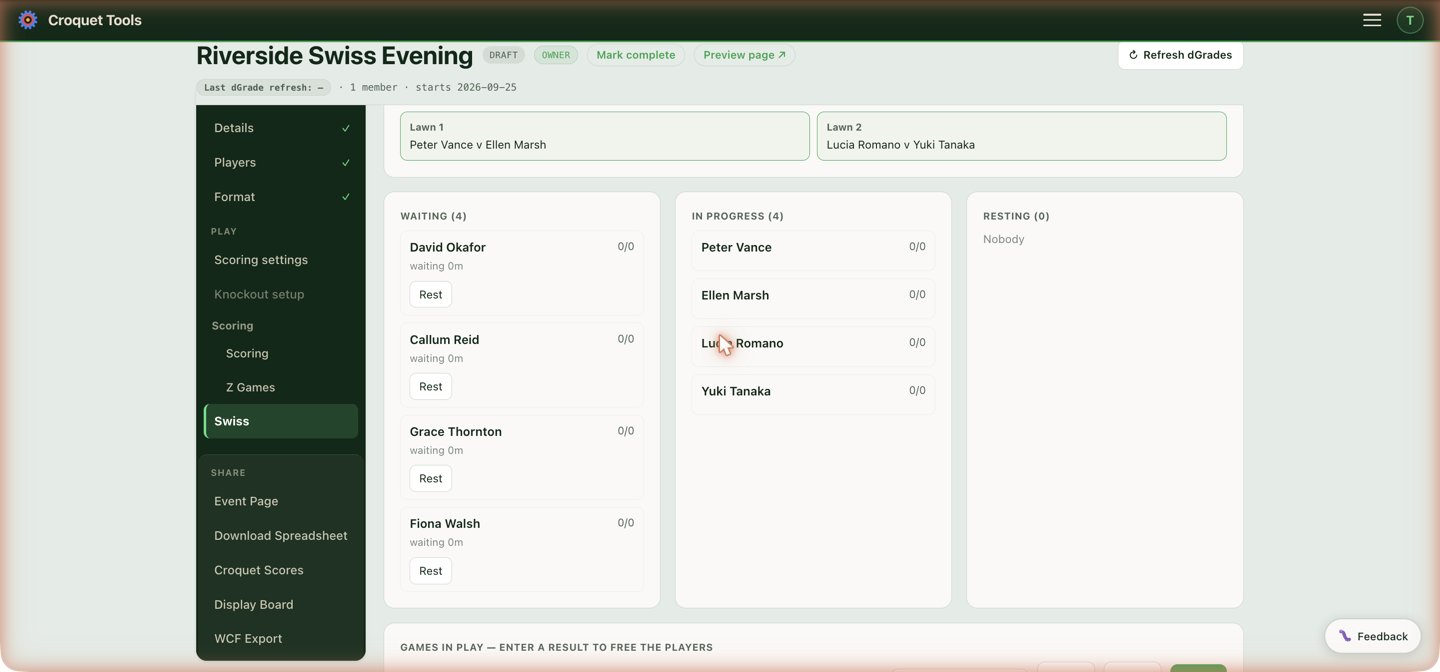
- Propose pairings — the tool suggests matches for waiting players and free lawns, balancing records, avoiding repeat opponents and respecting the Pair when waiting ≥ setting. The longest-waiting players are considered first; where they cannot be paired without a rematch (two who have just played each other, with a third player newly out of the main draw), the next-longest-waiting player takes a place instead and the proposal says who was passed over. A rematch is proposed only when nobody waiting is a fresh opponent. Review, then Start these games. Where a draw feeds this competition, the win percentage it ranks on is the full record — these games plus the ones carried in — so a beaten semi-finalist is not treated as a newcomer, and the weekend's first pool has something to rank on. Each player's figure on the board is that combined one; hover it for the split.
- Start a match by hand — pick two players and a lawn, Start match. The tool warns if the pairing is unfair or a repeat ("These two have already played — starting anyway") but does what you ask.
- Start a Z game — a one-off ranked game outside the pool, on a lawn now. Pick two people — the pool's players are listed first, under Waiting and Resting, then Elsewhere in the event for anyone else at the venue — and a lawn, then Start. The game takes its lawn on the lawn strip and gets a card in In progress marked Z, and both players leave Waiting until its result is in. It is scored under Z games in play below the board, with the same score row (or the AC sheet) as a pool game, or later on the Scoring tab's Z games list, where it shows as in play until then. Move to and Cancel game work on its card as on any other; there is no Peg down — an unfinished Z is scored or cancelled. The result counts for the WCF and never for this pool's table or anyone's record here; once it is in, both players go back to Waiting from that moment. The phone board does the same: + Start a Z game on its Matchups tab, the game on its lawn under Playing with a Z mark, and Score on either tab.
- Rest everyone — at close of play, moves everyone waiting to Resting, so there's no one left to propose games for.
- Move to on an In progress card sends that game to another lawn — use it when a game went out on the wrong one, or a lawn has to be handed back. A lawn with no room reads full and can't be picked. The same picker sits on the game's score row. The lawn pool comes from Details ▸ Venues & lawns.
- Cancel game on an In progress card un-starts a game that hasn't begun — a pairing sent out before the players on the next lawn had finished, or two names put together by mistake. It asks first, then removes the game and puts both players back in Waiting with the wait they had, so the next pairing can include them. A game with a result recorded is refused: clear the score first.
- Peg down on an In progress card takes a game off the lawn and keeps it. Enter the position in the two boxes and press Peg down at «score», or peg it without one and add the score later from the scoring sheet. The lawn is cleared, the game moves to Pegged down below the three columns, and both players go back to Waiting at the moment the game came off — not at the wait they had before it started. It counts for neither player while it sits there, and the pairing engine still treats the two as having met, so the board will not draw them against each other again.
- On each player card the figure at the top right is games won / games played. A card in In progress says which lawn the player is on now; the played on chips under any card are the lawns that player has already played a game on, which the pairing uses to spread players across lawns.
Where a draw feeds this competition — a consolation holding its field from day one, resting — Resting splits in two: Out of ⟨draw⟩ — free to play at the top, then Still in ⟨draw⟩ below, and anyone still alive in that draw carries a Still in ⟨draw⟩ pill wherever they appear on the board. Nobody is hidden and nothing is disabled: a player waiting on their next knockout game is exactly who a Flexible Swiss can give a game to. It re-sorts itself as results land.
Pegged down
A pegged game is in neither of the states the rest of the board is built on: it has been played but has no result, and its two players are free. It sits in its own section under the three columns, with the position it was pegged at and the time, and offers two ways out.
Resume puts it back — both players return to In progress and the game is scored like any other. It does not remember the lawn; pick one as you would for a new game.
Mark not played says it will not be finished. The game stays on the record as one that happened and was pegged down, and counts for neither player. Resume still reopens it.
Cancel game is refused on a pegged game. Cancel deletes a game that never happened; this one did.
Pegged games appear on the public event page and the display board in their own Pegged down list, with the position, so a player can see their game has not been forgotten.
The pacing settings
Pair when waiting ≥, Minimum games and Double-banking sit on the board itself, above the free-lawns count, and are editable there — they are what the board obeys, and the day is when you find out you want them different. They are the same settings the Format section asks for when the pool is created; changing them in either place changes both. All format settings → jumps to the rest.
Strict Swiss — fixed rounds
Create round slots builds the round structure (the Rounds count is set on Format); each round then offers Pair this round when its previous round's results are in — or Re-pair from seeds on round 1 and Re-pair this round after it, if entries changed. Standings run on the same tiebreaker chain as blocks, and the finishing-order editor is available for unbreakable ties.
Rematches across a carried record
Where this competition's record carries across from another — a Progressive Swiss — a meeting counts wherever it happened. Two players who met in the main draw are treated as having played, so the board will not propose them against each other while any repeat-free pairing exists, exactly as for two who met in this pool.
Swapping a name on a proposal is still allowed, and the pairing is marked already played in <competition> when it recreates a meeting from a source draw (already played for one inside this pool). As everywhere else, a repeat is only drawn when there is no pairing left without one.
Advantage GC on the console
In an Advantage competition the targets — Ann plays to 7 · Ben plays to 5 — are worked out from the players' handicaps and stated in three places on the console: on a proposed pairing before it is confirmed, on the In progress card for a game already on a lawn (beside each name), and on the game's score row. The scores at which the game would be a draw are printed alongside where those exist. A pairing made at the board never appears on a printed order of play, so this is where the targets are read.
The result is judged on scoring fraction, not on the raw score: the lower score can win the game, and a level score can be decisive. The console applies that rule to the running best-of tally and to the standings below, and it stores the targets with the game, so the same result reads the same way on the event page, the display board and in the knockout seeding. Where both players have run the same share of their target the row says so rather than refusing the score — that is a draw, and Advantage GC covers what to do about one.
The Standings table orders on net SF and shows it in place of net hoops, with the per-game figure beneath. A Swiss ranks on net SF per game, because game counts differ by design.
Burridge Swiss
The Burridge console runs the qualifying rounds and tracks who has reached the wins to qualify threshold, feeding the knockout as players qualify. The rounds, pre-drawn count and qualifying targets are set on Format; the brackets they feed live in Knockout setup.
Its Standings view groups players as Qualified, Still in (or Did not qualify, once every announced round is played) and Out, and draws a red Qualifying line under the last qualified player — derived from status, so an F8(c) lucky loser sits on the correct side of it. The same line appears wherever the pool's standings show in public: the event page's Scores tab, the standings board and the display board.
Once every announced round is drawn, an amber warning names any player left with no fixture and an undecided record — F8(b)(4)'s "a game short" case, where a cross-round carry or an odd final-round count runs a player out of rounds. The warning states what the lucky-loser rule (F8(c)) and Qualifiers wanted each do about it; as drawn, such a player does not qualify.
A withdrawal during a Burridge
Withdraw on the Players tab takes a player out of every later round. Once a Burridge has a pre-draw, withdrawing is always a status change and never a deletion, even for a player who has not played yet: the fixtures they were drawn into stay on the draw.
- Games they played stand for their opponents, as in any Swiss.
- Their unplayed games are not played. No result is entered and neither player gets a win, so each opponent finishes a game short. In the Rounds view the game is struck through with the player who withdrew named, and it leaves the scoring list. In Every player's draw the cell reads n/p.
- The Burridge completes without them. A not-played game counts as settled. The next round can be drawn, and Knockout setup and the plate treat the stage as complete once every other game has a result.
- A withdrawn qualifier is not a qualifier. They are left out of the qualifier count, so the knockout is built one smaller. Nobody else is promoted in their place.
- A withdrawn player is listed below the Standings and the player grid with their record. On the public event page they are struck through and marked withdrawn.
A worked example, 3 wins to qualify, 4 rounds pre-drawn:
| Round | Jimmy Jumper's fixture | Result |
|---|---|---|
| 1 | v P1 | won |
| 2 | v P2 | won |
| 3 | v P3 | won, qualified |
| 4 | v Pat Parker (withdrew before round 1) | not played |
Jimmy Jumper qualifies on 3 wins from 3 games. A player still in at the end who is left with a not-played game gets the same finishes a game short warning as above.
Reinstate brings every one of the player's games back as fixtures still to play.
Gotchas
Enter results promptly — the board can only propose pairings for players it knows are free. A finished game left unscored parks two players in In Progress and blocks a lawn.
Mark not played is not the undo for a Flexible Swiss game that is still on a lawn — it says the game will not be finished, which ends it without saying so. Cancel game is the undo for a pairing that should not have started, and the scoring sheet for a pool game says so in place of the button. Once a game is pegged down the button appears again: by then both players are already free, so it is a statement about the game rather than about them.
Related
Qualifying for the knockout
Where a handover reads this competition's results to fill a draw — a plate knockout taken from the combined record of the Plate and the main event — the qualifying table sits above the standings, and the standings below become the detail rather than the answer. Where the cut counts another competition's games as well as this pool's — a Progressive Swiss — the pool-only Standings table is not drawn at all: the qualifying table is the competition's record, and a second table with the same names and smaller numbers only raised the question of which was right. Where a tie was broken, the row says how — Level on % — behind Bea Medway on net hoops — which matters because the Net column is the whole event, while Reg F5(4) separates a tie on the games among the tied players, and only where they have all played each other. Where they have not, the backstop decides — net hoops, or quality of opponents where the handover says so — and the two figures agree; where they have, they can disagree by design. Above the qualifying line the rows are in seed order, and the same line names the seeding rule instead. The table holds the whole field, including players who have yet to play a counted game — they sit below everyone with a record, since there is nothing yet to rank them on. A # column numbers the rows, so a manager can count the table against the entry list. Each row's Games column lists that player's games across every competition the cut counts, winner's score first. The public page follows the same rule — its Standings view is the combined record, and the Swiss board and Rounds view show the games without a table under them. A plate whose cut counts only its own games keeps its Standings table in both places.
Each player carries one of five states:
| State | Meaning |
|---|---|
| In | Currently inside the cut, with their seed number beside them |
| Out | Currently below the line |
| Still playing | Not out of the main draw yet. Their games already count — that is what a Progressive Swiss means — but their place isn't settled until they're out |
| Not eligible | Barred by how far they went in the main draw, whatever their record |
| 2 of 5 games | Under the handover's Minimum games to take a place. Ranked where their percentage puts them, above or below the line, but not given a place until they reach the minimum — the seat goes to the next player at it, and reaching the minimum seats them. The event page shows the same |
The dashed line is the cut. Z games are not counted. Where the tiebreaks can't separate two players across the line, the table says so and leaves it to you — it will not invent an order for a qualifying place.
Set the rule itself on Pathway: who leaves, how many, and which round of the main draw bars a player.
Locking the field
The table is live: it shows who would qualify on the results in so far, and nothing is written into the knockout until you say so. Lock these 8 into {name} puts them in, in the table's own seed order — the draw's reserved seats stop reading "Seed 1 … Seed 8" and carry their names.
It asks first, and the question names what applies: any places not settled yet (players still alive in another draw), whether the event page is live — in which case the names are public the moment you lock — and any seats already played, which keep their names. Unlock sits beside the button afterwards, on this same card.
Lock whenever you are ready, and change your mind afterwards:
- Re-lock re-reads the table and rewrites the seats. Use it when a late result, a withdrawal or a corrected score moves the order.
- Unlock puts the seats back to "Seed 1 … Seed N". The players stay in the knockout's competition — removing them is a Format job — so a field about to be re-locked from nearly the same eight doesn't lose its entries in between.
Unlock asks you to confirm where it would be visible, and says what it would do:
- The event page is live. The draw is published, so anyone reading it there or on the display board sees seat numbers instead of names until you lock again. A test event is private, so it doesn't ask.
- Games are already on a lawn. A first-round game with a time keeps its slot and loses its names, so the order of play reads "Seed 3 v Seed 6" until you lock again.
With neither of those true there is nothing to see and nothing to lose, so it just unlocks.
A seat that has been played holds its name, and only that seat. Round one is who played — the scores belong to the top and bottom of that match — so locking and unlocking skip it and still move every other seat. The card says how many are held.
Played means anything entered against the match: a winner, a walkover, one game of a best-of-3, or a bare aggregate score. Nothing is remembered beyond that, so clearing a game's result hands its seats back and lock and unlock work on them again. Once every seat has been played there is nothing left to move, and a name is changed in the draw itself, in Knockout setup.
Locking while someone is still in the main draw is allowed and the table says so — their record counts either way, which is what a Progressive Swiss means, but whether they hold a place depends on a game that hasn't been played.
Arrivals
Where a handover feeds this competition — Anyone knocked out of the draw beside it, which is what a consolation is — a card above the board lists the players who are out of that draw and have no place here yet, deepest round first, with a count of who is already in.
Add all N → puts them in; the + on a name adds that one. Press it again tomorrow: anyone already here is skipped, so it is safe to work from repeatedly as more games finish. Adding somebody does not take them out of the draw they came from — they keep that entry, and its record still counts towards these standings, which is what a Progressive Swiss means.
Add only the players who want to keep playing. Not everyone knocked out wants a consolation game, and nothing fills this competition on its own for exactly that reason — a draw that filled itself would enter people who have gone home.
The card renders only when a handover of that kind exists, and only while somebody is actually waiting. Where the competition was built with Everyone, from the start — the Progressive Swiss builder's default, and the consolation card's — nobody ever is, because the whole field went in resting on day one; the card stays out of the way. An ordinary Swiss never sees it at all.